Catholic Funeral Flowers & Sympathy Etiquette: A Complete Guide
Catholic funerals welcome flowers — both at the funeral home for the wake, and at the Mass of Christian Burial itself. Flowers have been part of Catholic mourning tradition for centuries and remain one of the most common and welcome gestures from friends, family, neighbors, and coworkers.
Beyond flowers, Catholic tradition also includes some distinctive memorial gestures — most notably Mass cards — that may be unfamiliar if you’re not Catholic. Including a Mass card alongside flowers, or in place of them, can be a deeply meaningful gesture in Catholic families.
This guide covers both.
Quick answer: Flowers are welcome at Catholic funerals. Send them to the funeral home before the wake, and the funeral home will move them to the church if needed. White flowers, crosses, and hearts are the most traditional choices. The casket spray comes from the closest family, and a Mass card is a meaningful addition for a Catholic family.
Not sure what to send? Three safe choices
Picked from the Flowers Fast sympathy collection. Prices as listed on September 30, 2026, and may change.

For the family’s home
FTD Peace Lily Plant
$62.90
Good from coworkers, neighbors and friends. A plant keeps going long after cut flowers fade.
See this oneFor the service
Classic Sympathy Basket
$79.90
A safe choice from a friend, delivered to the funeral home. Gladiolus, carnations and mums.
See this oneFrom close family or a group
Love and Light Standing Spray
$139.90
Stands on an easel near the casket. A good choice when several people go in together.
See this oneWe may earn a commission if you order through these links, at no extra cost to you.
Are Flowers Appropriate?
Yes. Flowers are welcome at virtually all Catholic funerals and burial services. There are essentially no Catholic theological objections to floral tributes — flowers have been used in Catholic funeral rituals since the early church, and remain so today.
The exceptions are narrow:
- Good Friday and Holy Saturday services — if the funeral falls on these days (rare), the liturgical season restricts flower displays during the Mass itself.
- Family preference — if the obituary requests “in lieu of flowers, donations to…” honor that request.
Otherwise, send flowers without hesitation.
Where to Send Them
There are typically two phases to a Catholic funeral:
The wake (visitation)
A viewing held at a funeral home, where family and friends gather to pay respects, view the deceased, and console the family. This usually happens the evening before the funeral, sometimes spanning multiple days.
Send to the funeral home so flowers are displayed during the wake. Many families request that funeral home arrangements then be moved to the church for the funeral Mass — but the funeral home and the church will coordinate this if needed. You don’t need to manage it.
The funeral Mass (Mass of Christian Burial)
The actual funeral service, held at a Catholic church. Flowers may be displayed near the casket, on the altar, or near a memorial photo. Some parishes have specific rules about what can be displayed in the sanctuary — but funeral homes are familiar with the local parish’s preferences.
Send to the funeral home for delivery before the wake, and they will manage placement and transfer if needed.
If the Mass is held without a wake (sometimes called a “Mass of Christian Burial” or “Funeral Mass” with no preceding visitation), you can send flowers directly to the church. Confirm with the parish office first.
What Type of Arrangement?
All standard arrangements are appropriate at Catholic services:
- Standing sprays — most common, displayed on easels at the wake and often moved to the church
- Casket sprays — for immediate family only (spouses, children, parents, siblings)
- Cross-shaped arrangements — common at Catholic funerals, given the religious symbolism. Appropriate when sent by close family or friends.
- Heart-shaped wreaths — also common, often with white or pastel flowers
- Sympathy bouquets and plants — appropriate for delivery to the family’s home
A cross or heart arrangement is more traditional and feels more specifically Catholic than a general standing spray. If you want your arrangement to reflect the religious nature of the service, choose one of these shapes. If you prefer a more universal gesture, a standing spray or sympathy bouquet works equally well.
Catholic Funeral Flower Etiquette for Immediate Family
If you are the spouse, a child, a parent, or a sibling of the person who died, your flowers play a different role than a friend’s arrangement. Here is how families usually divide it up.
- The casket spray comes from the closest family. It is usually ordered by the surviving spouse, or by the children together if there is no spouse. There is normally only one. See our guide to casket sprays for sizes and styles.
- Adult children and siblings often go in together. One standing spray, cross, or heart signed “Your loving children” or “Your brothers and sisters” is common, rather than a separate arrangement from each person.
- Grandchildren often send one arrangement as a group. A heart or standing spray signed “With love, your grandchildren” is a common choice.
- Family flowers go to the funeral home or church. Bouquets and plants sent to the house usually come from friends, neighbors, and coworkers.
What happens to the casket spray at the church
At a Catholic funeral Mass, the casket is often covered with a white cloth called a pall as it enters the church. The pall is a reminder of the white garment given at baptism. For that reason, many parishes ask that the casket spray be taken off at the church door and set nearby during Mass, then placed back on the casket for the trip to the cemetery. The funeral director takes care of this. If the family wants the spray to stay in view during Mass, ask the funeral director what the parish allows.
Other arrangements from the family can usually stand near the casket or the memorial photo. Some parishes limit what can be placed near the altar, so let the funeral home handle placement.
Color Conventions
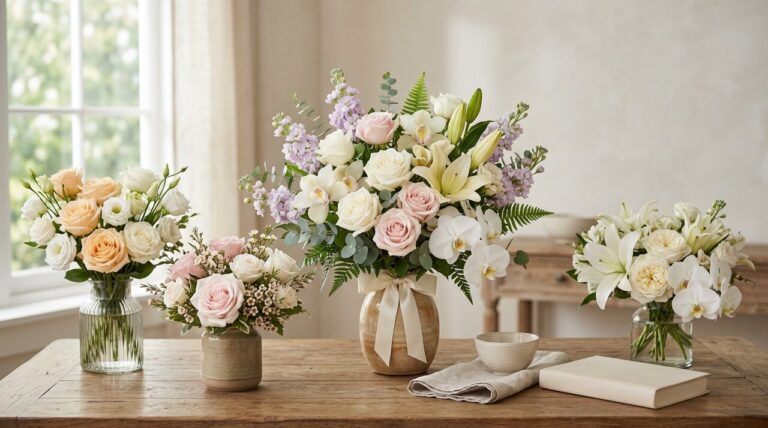
White is the most traditional color for Catholic funeral flowers. White symbolizes purity, peace, and the resurrection — themes central to Catholic theology. White lilies in particular are deeply associated with Catholic funeral tradition.
Other appropriate colors:
- Soft pink and pale yellow — gentle, warm, appropriate for nearly any sender
- Pale blue — sometimes used for Marian devotion (Mary, the mother of Jesus, is often depicted in blue)
- Cream and ivory — formal and traditional
- Red — appropriate when sent by close family, particularly for the loss of a parent
Bright multi-colored arrangements are acceptable when the family has indicated a preference for a “celebration of life” tone, but the convention is muted and reverent.
Mass Cards: A Distinctively Catholic Gesture
A Mass card (sometimes called a “Mass intention”) is a card from a Catholic priest or parish indicating that one or more Masses will be offered for the soul of the deceased. The card is then sent to the bereaved family.
For Catholic families, this is often the most meaningful gesture you can make — more meaningful than flowers, in many cases. It is a substantive spiritual act on behalf of the deceased.
How to arrange a Mass card
- Contact a Catholic parish — preferably the deceased’s home parish, if you know it, or any Catholic parish near you.
- Speak to the parish office or a priest. Tell them you’d like a Mass offered for the soul of [the deceased’s full name].
- There is typically a customary offering (a small donation) to the parish for this — usually $10-$25. The amount is not the point.
- The parish provides a card that you can mail or hand to the family.
Many Catholic charities — Society of St. Vincent de Paul, Catholic Relief Services, Maryknoll, the Pontifical Mission Societies — also offer Mass card programs where you can request a Mass for the deceased through them.
Mass cards can be sent alongside flowers, or in lieu of flowers. For a Catholic family in mourning, a Mass card from a friend or family member is a substantive, lasting acknowledgment.
Sending to the Home
For private gestures to the family’s home after the funeral, the same conventions apply as for other Christian traditions:
- Sympathy bouquets and plants are appropriate
- Mass cards can be sent here as well
- Food and casseroles for the family during the days after the funeral are always welcome
- A handwritten condolence note sent a week or two after the funeral is one of the most underrated gestures
What to Write on the Card
Religious phrasing is appropriate for Catholic recipients in most cases. Some examples:
For someone you knew well:
“With deepest sympathy on the loss of [Name]. He was a wonderful person and will be deeply missed. May he rest in peace. — [Your name]”
For a more formal Catholic phrasing:
“Eternal rest grant unto him, O Lord, and let perpetual light shine upon him. May his soul, and the souls of all the faithful departed, rest in peace. With deepest sympathy. — [Your name]”
For a Mass card:
“I have arranged for Masses to be offered for [Name]’s soul. He will be in my prayers and in my heart. — [Your name]”
If you are not Catholic but want to acknowledge the religious nature of the service:
“With deepest sympathies to your family. [Name] is in our thoughts and prayers. — [Your name]”
Sympathy Etiquette at the Wake or Service
A few notes if you’re attending:
- Genuflection at the casket — at a Catholic wake, it is customary to briefly kneel or bow at the casket before approaching the family. If you are not Catholic, you can simply stand quietly for a moment.
- Holy water or sign of the cross — if there is holy water at the entrance, Catholic attendees will typically dip their fingers and make the sign of the cross. Non-Catholic guests should not feel pressured to do so.
- The funeral Mass — non-Catholics are welcome to attend but generally do not receive Communion. Standing and sitting with the congregation is appropriate; reciting prayers you are not familiar with is not expected.
Timing
- Funeral arrangements should arrive at the funeral home before the wake begins
- Mass cards can be sent immediately upon hearing of the death and may continue to be sent in the weeks afterward
- Home gestures (sympathy plants, food, notes) can be sent any time from immediately after the loss through several weeks afterward
Ready to send sympathy flowers? Flowers Fast has a dedicated sympathy collection, with same-day delivery available in many areas.
We may earn a commission if you order through this link, at no extra cost to you.
A Final Practical Note
Catholic funeral etiquette is generally welcoming and forgiving. The tradition has been refined over many centuries and is comfortable with both flowers and Mass cards, both formal and informal gestures. You are unlikely to make a serious mistake.
If you can manage two gestures, send a Mass card for the spiritual significance and a sympathy plant to the home for the personal touch. If you can only manage one, choose whichever is more meaningful to you and your relationship with the family.